
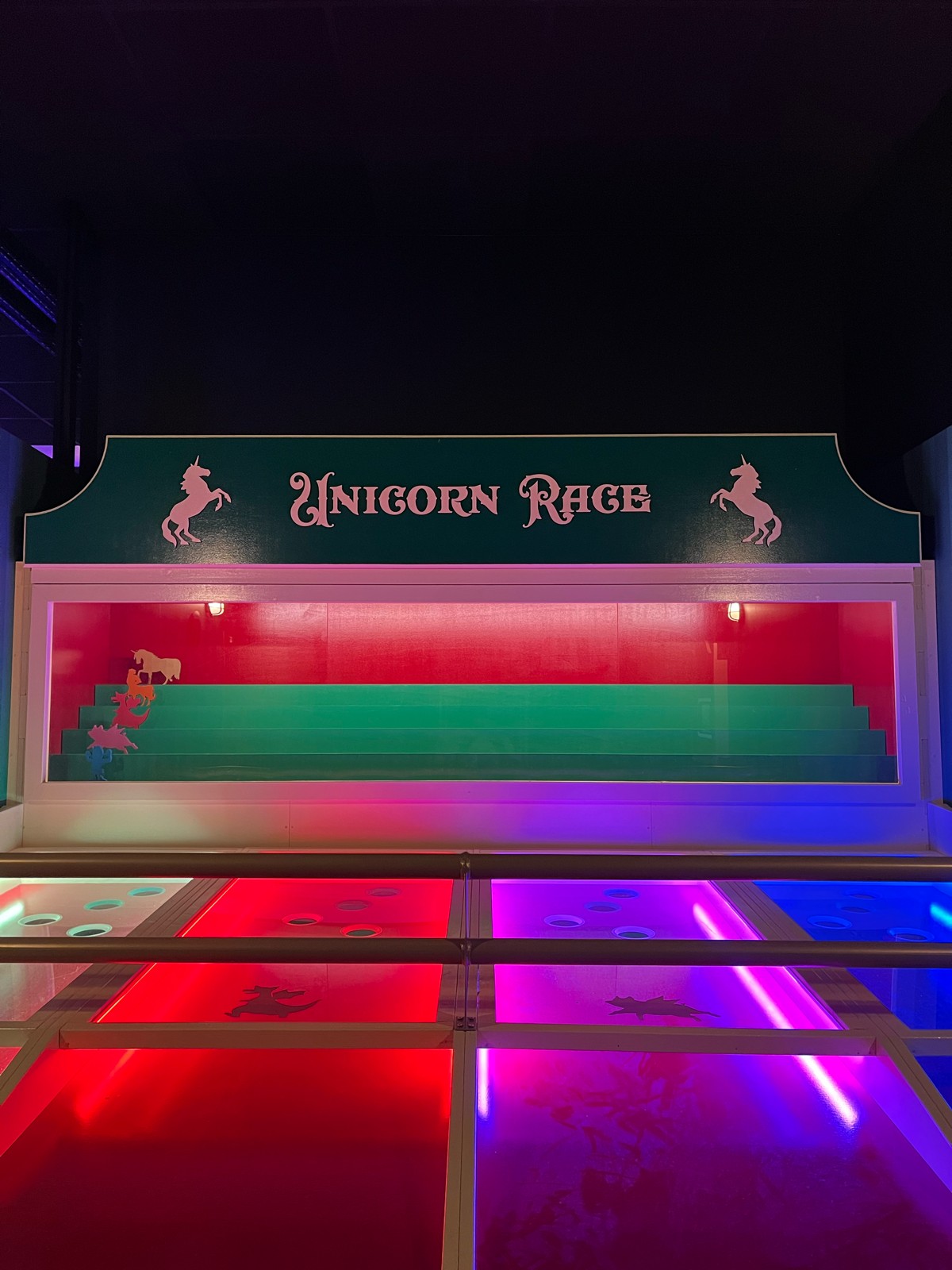
The immersive entertainment market is evolving rapidly. Following the boom in escape rooms in the mid-2010s, a new category is gaining traction in amusement parks, family entertainment centers (FECs), and professional gaming venues: action games. This format combines physical activity, a narrative storyline, and interactive technology to create an experience that is radically different from the traditional escape room.
However, the term “action game” remains poorly defined and is often confused with other formats (laser tag, paintball, physical escape rooms). This comprehensive guide provides a clear definition, explores the main existing formats, and explains how an operator can have a custom action game designed, from the initial brief to the grand opening.
What you'll learn
- The exact definition of an action game and how it differs from an escape game
- The 4 main genres of action games
- The steps involved in designing a custom action game
- How to Choose the Right Designer
- Case Study: Funfair Games by Kryptex for the Koezio Network
1. What is an action game? Definition
An action game is an immersive adventure format that places physical activity at the heart of the experience. Unlike an escape game, which focuses on solving intellectual puzzles within a time limit, an action game requires players to take physical action: running, crawling, aiming, coordinating movements, and overcoming obstacles.
Official definition
An action game is an immersive recreational activity in which players complete physical challenges in a story-driven, high-tech environment, either alone or as a team, with a shared goal. The story, setting, and technology provide the backdrop for the physical activity.
The action game is not a generic format: it is a category that encompasses multiple subgenres, each with its own constraints in terms of length, technology, and target audience.
2. The 4 main genres of action games
2.1 The narrative action game
The format most similar to an escape room. Players navigate a themed setting (spaceship, secret laboratory, ancient temple) and must complete a physical challenge to advance the story. Puzzles are replaced by actions: disabling a system while dodging lasers, transporting a fragile object through a trap-filled course, or coordinating a team across multiple areas simultaneously.
- Target audience: adult groups, corporate groups, team-building events
- Recommended area: 100 to 300 square meters
- Examples: Prison Break
2.2 Sports action games
The focus is on team physical performance. Teams compete against or cooperate with one another in scripted challenges that test agility, speed, or endurance. Real-time scoring and leaderboards create a strong competitive element. This format generates excellent word-of-mouth recommendations and a high likelihood of repeat participation.
- Target audience: families, teenagers, sports teams
- Recommended area: 200 to 500 square meters
- Examples: Funfair Games, Olympic Challenge
2.3 The Tech Action Game
Technology takes center stage. Motion sensors, projection mapping, real-time AI, and haptic interfaces: the game responds to players’ actions in spectacular and personalized ways. This format is the most expensive to develop, but it delivers the most memorable and Instagram-worthy experiences.
- Target audience: early adopters, tech-savvy families, premium events
- Recommended area: 80 to 200 square meters
- Investment: starting at €150,000
2.4 Event-based action games
Compact and portable, ideal for corporate events, trade shows, and brand activations. The event-based action game can be set up in just a few hours, accommodates groups of 4 to 8 people, and can be set up in any space. It’s the most accessible format for a first project.
- Target audience: businesses (works councils, executive committees, team-building events)
- Space required: 20 m² or more
- Advantage: Quick ROI, shared across multiple sites
3. Why action games are becoming a staple in amusement parks
The immersive entertainment market is entering a phase of maturity. After a decade of growth, the traditional escape room is facing market saturation in certain cities and an increasingly demanding customer base. Action games address three unmet market needs:
- Shorter, more accessible experiences. The duration of an action game session (20 to 45 minutes) is better suited to tourist traffic and family schedules than the rigid 60-minute format of an escape game.
- A wider audience. The action game breaks down the cognitive barrier associated with escape rooms (“I’m not good at puzzles”) and is suitable for children as young as 6–8 years old as well as seniors.
- A higher repeat purchase rate. The physical and competitive nature of the game creates a desire to come back and improve, unlike in an escape room, where replaying the same scenario doesn’t make sense.
Key Market Figures (2025)
- 40% annual growth for “immersive physical” formats in Europe
- Average price for an action game: €18–25 per person (vs. €25–30 for an escape game)
- Hourly capacity 3 to 5 times that of an escape room for the same floor space
- Average recommendation rate: 87% (source: Koezio/Échappe-toi operators)
4. How to Design a Custom Action Game: 6 Steps
Step 1 — Brief and Strategic Scope
Every action game project starts with a detailed brief. The key decisions to be made right from the start:
- What is the primary target audience? (families, adults, corporate, mixed)
- What is the available floor space? (architectural constraints, ceiling height, fire department access)
- What is the investment budget? (manufacturing, electronics, software, installation)
- What business model? (pay-per-game, flat rate, subscription)
- What is the target session duration?
An experienced designer like Kryptex will guide you through this scoping process even before you begin the design phase. This is the stage where projects are made or broken.
Step 2 — Storyboarding and Game Design
The storyline isn't just a backdrop: it's the emotional framework that gives meaning to the physical actions. Good action game design defines:
- The narrative arc (beginning, rising action, climax, resolution)
- Game mechanics (actions, rules, scoring)
- The difficulty curve (gradual increase in tension)
- Decision points (player choices that shape the experience)
At Kryptex, game design is handled in-house by designers with backgrounds in the video game industry and professional escape rooms.
Step 3 — Technical Design and Prototyping
The technical phase includes architectural plans, the design of physical mechanisms, electronic specifications, and the development of control software. Kryptex uses proprietary software that allows all game components to be controlled from a centralized interface.
A working prototype (or 3D digital model) is presented to the client for approval prior to manufacturing.
Step 4 — Manufacturing and Integration
Manufacturing takes place in-house, leveraging expertise in set design, woodworking, embedded electronics, and programming. Kryptex assembles all components at its facilities in Saint-Étienne before shipping them to the site.
Step 5 — Installation and Training
On-site installation involves a team of technicians who will assemble, wire, test, and calibrate the exhibit. Comprehensive training for operational staff (facilitators, managers) is included. The proprietary control software is provided along with documentation and support.
Step 6 — Monitoring and Progress
An action game is a living product. Kryptex offers maintenance contracts, story updates (narrative revamps without a complete overhaul), and content expansions to build long-term customer loyalty.
5. Case Study: Funfair Games for Koezio
The Project at a Glance
- Client: Koezio (network of immersive entertainment parks, France)
- Genre: Multi-team sports action game
- Deployment: 4 Koezio centers (Lyon, Lille, Cergy, Sénart)
- Designer: Kryptex (Saint-Étienne)
- Project duration: 14 months (from brief to opening)
The challenge
Koezio wanted to revamp its offerings in spaces ranging from 400 to 600 square meters within its centers, creating an experience capable of accommodating groups of 20 to 40 people at a time, whether families or corporate groups. The goal was to create an attraction that could be replicated across multiple locations while maintaining a premium experience.
The Kryptex Solution
Kryptex has developed Funfair Games, a sports action game set in a dystopian carnival. Players compete in teams across eight simultaneous game zones, each featuring a different physical mechanic: precision, speed, balance, and coordination. A real-time scoring system displays the results on giant screens in the central area.
Results
- Successful rollout across four centers within eight months of the opening of the first site
- Customer satisfaction rate: 91% (Koezio post-visit surveys)
- Average occupancy rate: 78% over the first six months
- Capacity: approximately 120 players per hour per center
6. How do you choose an action game designer?
There are few developers in France capable of delivering a full-fledged action game. Here are the key differentiating factors to consider:
- Choose a designer who can handle the entire process: Full-service or specialized approach
planning → manufacturing → electronics → software → installation → training. A project involving multiple contractors increases the risks associated with coordination.
- A designer who excels at escape games isn't necessarily an expert in physics-based action games. Ask for specific references. Portfolio of work in your category
- Proprietary software ensures independence and long-term support. Third-party solutions create problematic dependencies. Proprietary software or third-party solution
- If your project involves multiple sites, check the designer’s logistical capacity (workshop, installation teams, parts inventory). Multi-site deployment capacity
- The action game causes system crashes and requires updates. Insist on a maintenance contract with a defined SLA. Post-installation support
Why choose Kryptex for your action game?
Kryptex is one of the few French designers to offer a full-service solution for escape rooms: design, manufacturing, electronics, proprietary software, installation, and training—all from our workshops in Saint-Étienne. As a subsidiary of the Échappe-toi Group (Montreal), we operate in France, Canada, and internationally, with over 300 projects completed. Contact us at kryptex.fr to discuss your project.
FAQ — Frequently Asked Questions About the Action Game
What is the minimum screen size required for an action game?
The minimum space required depends on the format. A compact, event-based action game can be set up in 20 m². A standard narrative action game requires 100 to 200 m². A multi-team sports action game requires 300 to 600 m². Kryptex tailors its design to your available space.
What is the budget for a custom-made action game?
A custom action game project typically starts at €80,000–€100,000 for a compact format (event-based escape box) and can exceed €400,000 for a full-scale multi-zone sports action game. This budget includes design, manufacturing, electronics, software, installation, and training.
How long does it take to develop an action game?
A standard project takes between 6 and 18 months from the initial brief to the grand opening. This timeline includes: initial brief (1 month), design and approval (2–3 months), manufacturing (3–6 months), installation and testing (1–2 months). Kryptex coordinates the entire project with a dedicated project manager.
Is the action game suitable for children?
Yes, starting at ages 6–8, depending on the format. Physical action games are often more accessible to children than escape games, as they don’t require puzzle-solving skills. Kryptex offers game designs tailored for families with inclusive mechanics.
Is it possible to update an existing action game without completely remaking it?
Yes. Thanks to the proprietary Kryptex software, it is possible to modify scenarios, scoring rules, and certain technological elements without having to completely redesign the set. Kryptex offers annual upgrade contracts to keep the attraction appealing.
Does Kryptex ship outside of France?
Yes. Kryptex operates in France, Canada (through the Échappe-toi group in Montreal), Belgium, Switzerland, and other countries upon request. Our installation teams are available for international deployment.